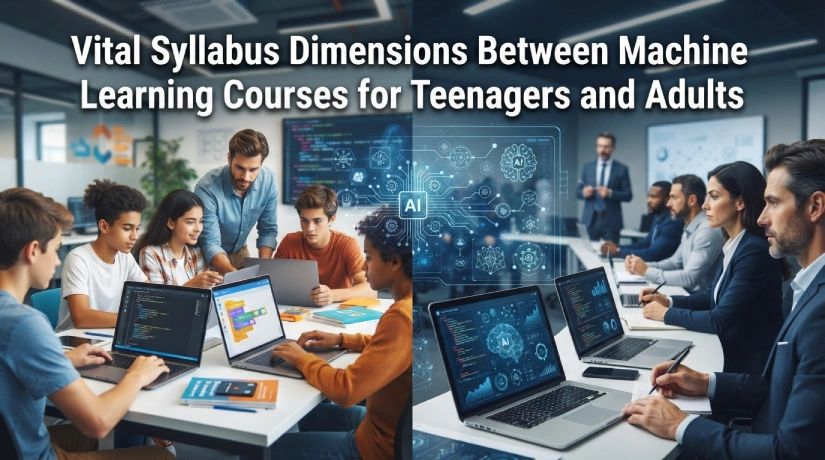
Vital Syllabus Dimensions Between Machine Learning Courses for Teenagers and Adults
Machine learning is transforming the way we interact with technology, from personalized suggestions and voice assistants to self-driving cars and intelligent healthcare systems. As this sector evolves rapidly, learning its fundamentals has become an exciting opportunity for students and working professionals alike. However, machine learning courses for teenagers and adults are not quite the same. While adults might prefer structured technical knowledge that supports career advancement, teenagers benefit from an engaging, practical, and age-appropriate introduction to artificial intelligence.
Machine learning courses for teenagers are designed differently from programmes intended for adult learners. The right curriculum should introduce complex concepts through relatable examples, interactive activities, and hands-on projects without overwhelming young minds. Additionally, it should motivate curiosity, problem-solving, and logical thinking at an early age. In this comprehensive blog guide, we will discuss some fundamental structural differences between machine learning courses for adults and teenagers that can help parents and students choose a programme that builds strong foundations while making the learning experience enjoyable, future-ready, and meaningful.
Key Structural Differences Between Machine Learning Courses for Teenagers and Adults
Here are some vital differences between machine learning courses for teenagers and adults that every parent should know if they are enrolling their children in this programme:
1. Learning Goals and Expected Outcomes
The machine learning courses for teenagers are aimed at increasing awareness, curiosity, and providing basic skills. Teenagers learn what machine learning is, how algorithms detect patterns, and what kinds of intelligent machines we use in our daily lives. In turn, the adult learning goals often concentrate on professional application, specific knowledge, and practical results. For example, such programmes may include developing prediction models, improving company processes, or getting prepared for the technical profession. In this way, the expected outcomes vary depending on learners’ previous experience and their career perspectives.
2. Complexity of the Course Syllabus
To become a student who will not be scared of complex technical terms, teenagers require a syllabus that will introduce these notions step by step. Thus, instead of starting to study complicated mathematical formulae or algorithms right away, teachers demonstrate the topic by means of illustrative examples and demonstrations. Meanwhile, the adult learners are able to work with more complicated material, such as statistical models, optimization methods, and algorithms.
3. Learning Approach and Classroom Atmosphere
A lot depends on how the learning approach impacts learners’ understanding of machine learning. For teenagers, it is better to teach via interactive classes, demonstrative presentations, quizzes, storytelling, and guided coding. Adults tend to learn better with lectures, discussion, self-study, and industry-related tasks. Both methods involve participation. However, the learning atmosphere depends on the age, focus time, and previous knowledge of the learners to bring actual educational results.
4. Technical Background and Learning Needs
Teenagers can have different levels of technical education while joining the machine learning courses for teenagers, meaning that the course curriculum should start with basic programming first and then proceed to more complex topics like data processing, algorithms, and modeling. Adults who join special courses may already know how to work with such programming languages as Python and have certain knowledge of mathematics or statistics.
5. Practical Projects and Their Implementation
Practice makes machine learning more understandable to all ages. Nevertheless, project choice should be aligned with the interests and skills of the learner. Teenage learners may engage in developing recommendation systems, image recognition, and other prediction projects. Adults may engage in customer segmentation, financial predictions, business analysis, and other applications. Machine learning courses for teenagers should be aimed at providing opportunities for creativity and experimentation, which enables students to get a better idea about the principles of intelligent machines by working with relevant projects that are easy to present and explain.
6. Evaluation Methods and Progress Tracking
Evaluation is another crucial criterion that distinguishes programs for young people and adults. Teenage learners would benefit from frequent feedback, smaller assignments, coding challenges, demonstrations, and project presentations. All these methods enable instructors to detect any existing knowledge gaps and motivate learners. Programs for adults may include testing, independent projects, portfolio evaluations, practical problem solving, and so forth. Instead of measuring everything with test results, teenage programs should measure theoretical understanding, creativity, participation, and application of new skills.
7. Learning Speed and Long-Term Development
Teens need enough time to grasp fundamental concepts and build up their technical skills. A slow pace will help them move from programming basics to data analytics and then machine learning applications. Adults can opt for fast-track programs because they have certain objectives in their careers or do not have much time to spend studying. Therefore, machine learning courses for teenagers should focus on continuous development rather than covering advanced topics.
Reasons to Choose MasterJi Coding Classes for Machine Learning Courses for Teenagers
The selection of a suitable platform could make quite a difference in helping teenagers adapt to new technology. It is not enough to give the youth theoretical knowledge. They require a conducive atmosphere where they can ask questions and be curious about what is being taught. At MasterJi Coding Classes, we make technology education accessible to learners and engage them by exposing them to ideas that will help them academically and in their future endeavors. Below are some considerations when choosing machine learning courses for teenagers:
- Age-Appropriate: Theoretical concepts are introduced in such a way that they can be understood by children.
- Practical: Through practical exercises, students can link their knowledge to applications in real life.
- Good Fundamentals: Learners gain basic skills in programming and computation.
- Interactive Learning: The learning process is fun to ensure engagement.
- Problem Solving: Students are taught how to solve problems in a logical manner.
- Technology Literacy: They become familiar with new technology and advancements in artificial intelligence and machine learning.
It’s Time to Conclude Here!
Machine learning is becoming more and more integrated into contemporary education, so it becomes vital for students to get acquainted with intelligent technologies from an early age. Yet, no matter how beneficial these skills could be for them in the future, acquiring them should never be seen as something superfluous in their academic lives. Teenagers have to be offered chances to experiment, ask questions, and discover how the technologies can help them solve daily tasks. All this can contribute to their transformation from mere curiosity into skills and independence.
At MasterJi Coding Classes, we provide an opportunity for young learners to get familiar with the technologies of the future. Our machine learning courses for teenagers are designed to make technical education enjoyable and interesting. Give your child an excellent chance to understand the world of artificial intelligence and intelligent technologies. Learn more about our wide range of coding courses and start your child’s fascinating journey into machine learning!
Frequently Asked Questions
Teenagers may start acquainting themselves with machine learning basics at an early secondary school age. The most appropriate age varies according to their mathematical background, interests, and knowledge of the basics of programming.
Not necessarily. Prior programming experience is not required to start learning programming from scratch and then continue to apply this knowledge to machine learning.
Main subjects include:
- Basics of artificial intelligence and machine learning.
- Basics of Python programming and data manipulation.
- Basics of algorithms, pattern recognition, and model creation.
The choice of Python for machine learning courses lies in the simplicity of its syntax and wide range of machine learning libraries. Learning its basics may help to understand machine learning applications.
It helps to develop logical and analytical skills, creativity, and problem-solving skills. Moreover, it introduces the learners to the technologies which become increasingly important in different industries.