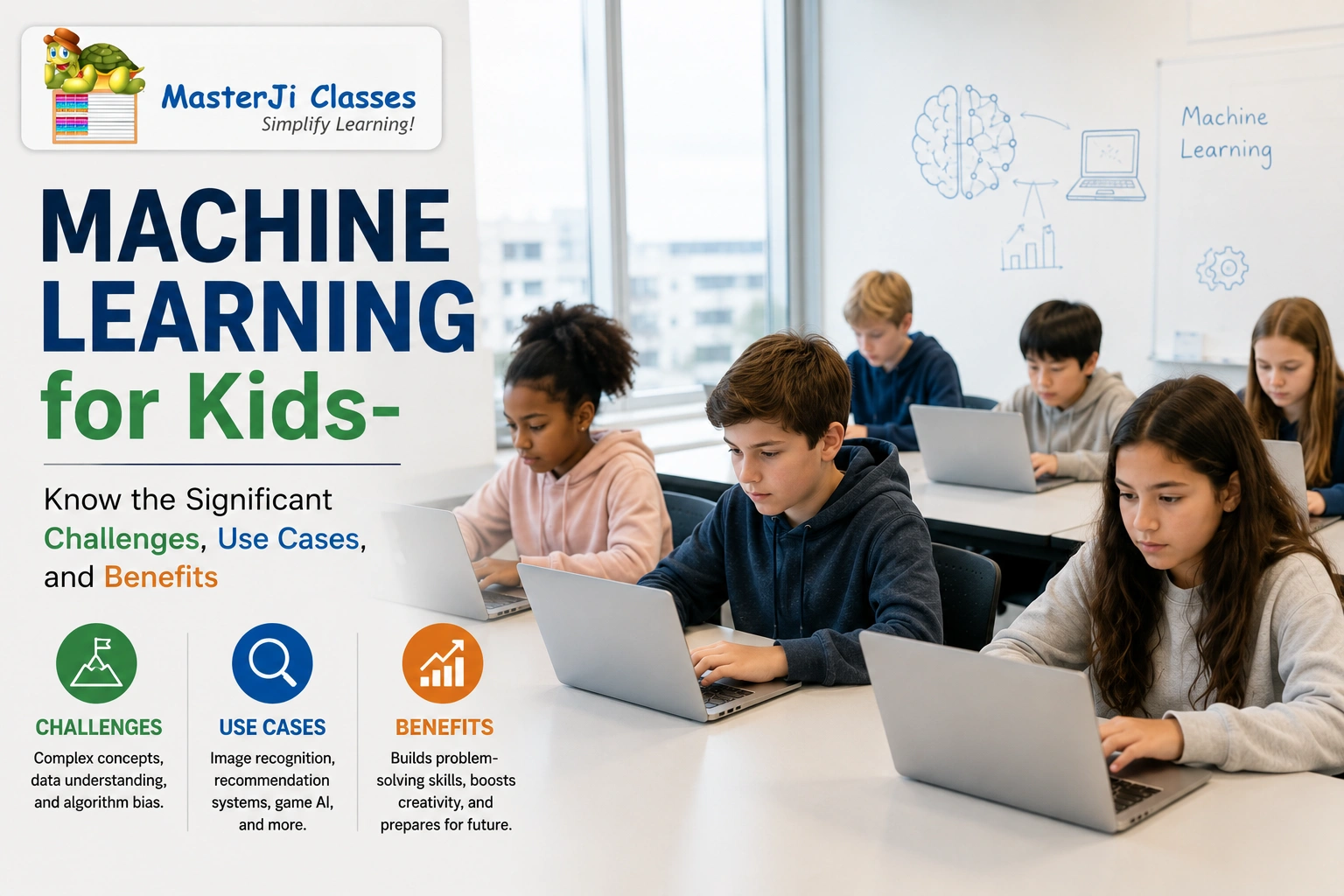
Machine Learning for Kids- Know the Significant Challenges, Use Cases, and Benefits
It is the brainstorming phase when kids ask numerous questions in a world where technology is growing rapidly. Sometimes they will ask you how YouTube works and play the next songs automatically, or suggest other songs, or ask why their favorite video games suddenly become hard after completing a certain level. Well! As parents, you have to provide answers they can understand seamlessly via physical examples. So, before giving answers to your toddlers, let’s learn more about machine learning for kids.
Machine learning is a type of artificial intelligence that’s already building the digital world for kids so that they can interact everyday. It is one of the most demanded roles when it comes to the job market. Machine learning is a significant part of Artificial Intelligence and has the capacity to learn like a human being without being programmed. With the rapidly expanding popularity, machine learning has become well-known for business organizations, and many are opting for Machine Learning as their potential career prospect.
Imperatively, this sector is also maximizing prominence among youngsters, especially high school kids. Additionally, in this comprehensive guide, we will discuss the fundamental benefits, challenges, and use cases in machine learning for kids. So, let’s get started with the blog.
What is Machine Learning for kids?
Children are becoming tech-savvy, and coding is not a complicated topic anymore, where children need to be forced to learn the overall tech algorithms. As we all know, data plays an essential role in many organizations. The best way to make your kids fall in love with this data revolution is through machine learning. Whether they are watching YouTube or playing video games, kids are already used to how computer devices work, and certainly, these are the best examples of machine learning for kids they experience every day. However, indulging your kids in machine learning is not rocket science.
Due to the vast amount of technology, kids show more enthusiasm than adults when it comes to learning artificial intelligence or machine learning. Well, just like engineers, kids also need to learn programming languages, such as JavaScript, Python, and Java. Taking coding classes is the first step on the ladder for kids to get into machine learning. In addition, learning about AI data annotation along with programming languages can help kids understand how machine learning models are trained and identify things using labeled data.
What are the Significant Challenges of Machine Learning for Kids?
There are numerous difficulties that an artificial intelligence development company could experience when developing a child-oriented application with ML. Let us look at these challenges in depth:
1. ML Conceptual Complexity
The understanding of the principles of machine learning for kids is the greatest challenge in educating this subject matter to children. Kids face great challenges in understanding the fundamentals of ML concepts, regardless of the advancement in technology. Parents and teachers need to educate children on machine learning to obtain valuable knowledge and avoid getting into complicated situations. In the case of older kids, the opportunity to buy coursework online can help them understand those ML concepts.
2. Concerns about Data Privacy
Using ML for kids’ applications raises data privacy concerns as it involves the use of personal data. The safety of children’s personal information, along with their biometrics, of an AI tool has to be secured in order not to disclose their personal information. Hence, programmers as well as teachers need to take measures to protect data privacy to avoid privacy breaches.
3. Requirement for Adult Supervision
Though machine learning for kids is entertaining and exciting, it needs to be done with adult supervision to become useful. Both parents and teachers need to understand machine learning concepts in order to guide the children in the process and understand the results. Such dependence on adults can be viewed as a drawback by some families.
Use Cases of Machine Learning for Kids that You Must Know
There is no denying that ML has been used to design child-friendly applications and tools for some years now. Whether it is developing games that help with learning or reflecting on the curious mind of scientists, there are many instances where machine learning has been used for children, and worth taking notes.
1. Machine Learning Games for Education
Machine learning-based educational games are becoming very popular because of the personalized learning approach they offer. The games can learn from the knowledge of the children and dynamically adjust to their level of knowledge without ever making them feel challenged. Math-based education games such as DragonBox use machine learning algorithms to educate students about math through interactive gaming.
2. Personalized Learning Applications
Personalized learning can be considered to be one of the best applications of machine learning for kids, as these algorithms try to identify the weakness and strengths of each learner as well as their learning rate and preferred learning style so as to offer customized courses. There are many such applications like 360 Learning and Dreambox that use ML algorithms to provide customized streams of learning for math, science, and reading.
3. Art and Music Generators
One of the great things about machine learning for children is that they can explore their creative abilities in different ways. Some software, such as Google’s Magenta and AIVA, enables children to compose computer art or music. They get to learn some technical terms related to neural networks and pattern recognition in the process.
Vital Benefits of Machine Learning for Kids
The use of machine learning in itself has some inherent advantages for kids if used rationally. Making use of machine learning child-oriented applications from trustworthy machine learning software development companies will enable kids to have benefits like;
1. Improvement in Problem-Solving Skills
Improvement in problem-solving skills is the biggest advantage of Machine Learning for kids. Through machine learning-oriented applications, kids will get motivated to think critically, debug, and look at things from varied perspectives. These are some of the essential skills to develop in school and will help kids become good in spirit in their future careers.
2. Improvement in Computational Thinking Skills
Machine Learning for Children helps children become computational thinkers, which is the basis of coding and problem-solving in modern times. Through Machine Learning algorithms, children learn how machines learn about patterns and make decisions. These basic concepts form the building blocks for future advanced learning in computer science and data analytics.
3. Development of Creativity and Innovation Skills
Creativity does not only involve making music and art in the concept of ML, but also creates new problem-solving ideas. Machine Learning enables kids to create music, art, and robotics by making use of their creative thinking processes. Kids learn that creativity is not only in the arts but also in technical fields, and become experimental kids.
Wrapping It Up!
We hope this comprehensive blog post has provided you with all the precise details about the importance, challenges, and real-time use cases in machine learning that kids have to deal with. Nevertheless, as we all witness the increasing rate of digital technology and how kids are showing their interest in the tech industry. That is why it is significant to enroll your kids in the best classes that provide basic to advanced-level Machine Learning.
Furthermore, if you are searching for the best classes of Machine Learning for kids, look no further than MasterJi Coding Classes. With experienced and skilled teachers, we ensure to kick-start and nourish your kids’ minds into the digital world. To know more about our Machine Learning classes, connect with our team today!
Frequently Asked Questions (FAQ)
Despite being quite an intricate concept, machine learning is rather easy to study as long as age-appropriate lessons are used and illustrated with examples. Children are not required to have advanced knowledge about mathematics and programming at all. It is possible to discover the subject through games, coding, and other fun practices with AI technologies. With regular practice and appropriate instructions from parents or teachers, children can gradually become familiar with AI concepts and build their own machine learning projects.
There are several basic skills that children should learn before starting to learn machine learning:
- Computer and general digital literacy.
- Logical reasoning and problem-solving skills.
- Elementary mathematics, including patterns and statistics.
- Basics of coding, preferably Scratch or Python.
- Curiosity, creativity, and an experimental approach to technology.
Children use various technologies built on machine learning principles quite often without even realizing it. Streaming services recommend videos depending on their history, voice assistants recognize spoken phrases, education apps provide personalized lessons, and online games adapt the difficulty level depending on a person’s performance.
As artificial intelligence transforms a wide range of industries, machine learning is becoming one of the most valuable future-ready skills. Studying machine learning, children develop analytical thinking, creative approach, and problem-solving skills, preparing themselves for the future career in such fields as AI, robotics, medicine, gaming industry, cybersecurity, and data science. Moreover, learning machine learning gives children an opportunity to understand the technology they use every day.