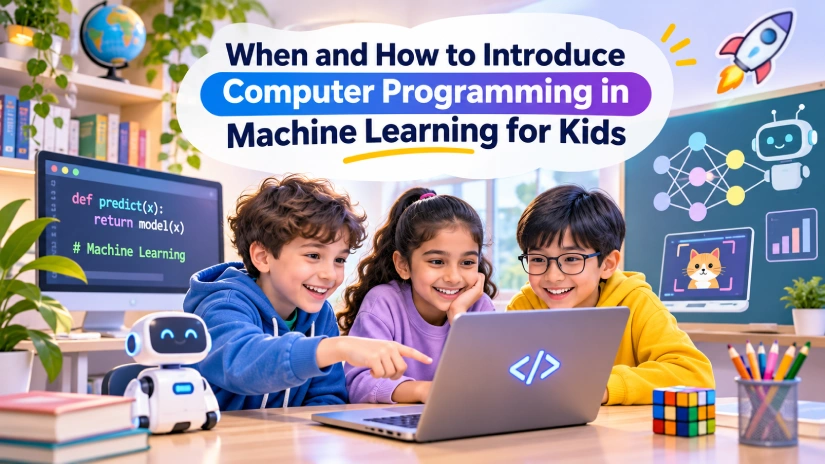
When and How to Introduce Computer Programming in Machine Learning for Kids
Introducing computer programming at the right age can enable children to acquire the right knowledge that will allow them to understand technological advances. With artificial intelligence being an integral part of modern life, the need for learning machine learning for kids is increasingly becoming popular among parents and educators who wish to prepare children for the future dominated by technology. Learning about these topics, however, does not necessarily require children to delve into complex programming code and calculations from the outset. Children can start by solving puzzles, looking out for patterns, and learning how machines learn through examples.
Moreover, the key is to introduce programming gradually, using age-appropriate lessons, practical projects, and interactive tools. Instead of expecting kids to master coding instantly, parents should motivate curiosity, creative thinking, and experimentation. With the right learning approach, kids can develop computational thinking while discovering how technology solves real-world problems. Therefore, this foundation makes machine learning for kids easier to understand and more enjoyable to explore.
Requirement of Programming in the Machine Learning Journey
Programming helps kids learn about the processes used by machine learning algorithms to interpret data, recognize patterns, and predict outcomes. Despite the availability of beginner-friendly platforms where kids do not need any programming knowledge to train models, programming enables better comprehension of the process itself. Acquiring the basics of programming, such as variables, conditional statements, loops, and data manipulation, equips kids with skills required to design more advanced programs as their knowledge increases. In addition, programming teaches logic, problem-solving, and analytical skills.
For instance, a child can write a program capable of image classification, speech recognition, or outcome prediction based on examples. Such projects provide an opportunity to relate theoretical knowledge to real-world tasks. Moreover, programming teaches kids how to experiment with ideas, detect mistakes, and find solutions. This combination of technical skills and independent thinking creates a solid basis for future studies in AI, robotics, and data science.
The Best Time to Teach Kids Computer Programming
There is no optimal age for every individual child to start learning how to code. The best possible age depends on many factors such as a child’s interests, attention span, self-confidence, and problem-solving skills. Parents can introduce programming in machine learning for kids using fun activities and can increase the level of difficulty according to children’s progress.
1. Ages 4-6: Learning Order Using Puzzles and Games
At this age, children are still too young to learn programming syntax. However, parents can introduce programming-related skills to their children using puzzles, sequencing games, and instruction-following games. Children can easily develop logical thinking and get ready for learning the basics of coding without using computer screens. One of the most entertaining ways is playing with toys that require following instructions.
2. Ages 7-9: Start With Visual Programming
Children of this age have enough skills to start learning a block programming language. Using visual programming, they can create animations and simple stories and games. This type of coding helps children to think logically without having to remember complex code. In addition, this age is perfect for introducing pattern recognition as well.
3. Age 10-12: Learning Coding and Machine Learning in Parallel
With growing capacity for logical thinking, children will be able to use beginner coding platforms and learn machine learning for kids through structured projects. The tasks include teaching a computer to detect an image, categorize objects, or analyze datasets. This teaches kids how examples of training affect the predictions and introduces them to such concepts as accuracy, testing, and quality of data.
4. Ages 13+: Building Bigger Projects
Teens can move on to text programming, preferably Python, and work on more complex machine learning flows. Kids will be able to work with various datasets, train different models, test and optimize their code. This age group is best suited for project-based learning. Students must also learn about responsible AI, privacy, bias, and other ethical issues related to technology.
The Right Way to Introduce Computer Programming in the Curriculum
Below are effective ways parents and teachers can develop a framework for learning to include both programming and machine learning.
1. Start With Computational Thinking
Instead of teaching programming and machine learning for kids with complicated code and tools, start by helping kids learn how to deconstruct problems. Activities such as puzzles, patterns, sorting, and instructions offer an easy way to start. Children could learn how to create instructions to sort items according to colour or size. This will help them learn about sequencing, reasoning, and problem-solving, which will be important in programming and machine learning.
2. Start With Block-Based Programming
Children learn about programming logic using visual programming languages without encountering challenges like spelling mistakes and syntax. Through block-based coding, kids can create characters, animations, games, and stories. Children can learn about events, loops, conditions, and variables, among other concepts in programming.
3. Relate Programming to Real-Life Examples
Learning will be enhanced when children can relate theoretical aspects to their practical counterparts. Machine learning for kids can be introduced through real-life examples such as music recommendations, spam filtering, speech recognition, and picture recognition, among others. These examples will later be linked to basic programming tasks such as sorting animals into different classes and identifying distinguishing attributes that help them make the process of pattern recognition easier.
4. Teach Children Data Collection Before Introducing Them to Machine Learning
Collecting and handling data plays a critical role in machine learning. Thus, children need to appreciate the significance of examples in the performance of the model. They can engage in gathering basic data, organizing the data into classes, and recognizing the patterns within. An example of a task can include grouping fruits according to colour, size, or any other attribute.
5. Engage Children in Practical Machine Learning Projects
Children can be encouraged to work on guided machine learning projects using tools appropriate for their age group. These projects may include training an image classifier, developing a gesture recognition application, and creating a recommendation system, among others. Children should be encouraged to make predictions, run experiments, and analyze the unexpected outcomes.
6. Move to Text-Based Programming Gradually
After children gain sufficient skills in visual programming, they can move to text-based programming when ready. Python is usually one of the preferred choices for text-based programming because of its readable syntax and wide use in machine learning for kids. Children should start by writing short programs that deal with variables, conditions, loops, and lists before datasets and models.
Concluding Note from MasterJi Coding Classes
Computer programming and machine learning for kids can open new exciting opportunities for kids to explore ideas, develop practical skills, and solve problems. The most effective learning experience combines age-appropriate instruction with experimentation, steady progress, and creativity. When kids understand the potential logic behind technology, they become better equipped to question results, evaluate details, and turn their creative ideas into working projects. Early career exposure should focus on building confidence rather than rushing towards advanced concepts. However, if you are searching for the best classes for machine learning for kids, look no further than MasterJi Coding Classes.
At MasterJi Coding Classes, kids can explore coding through structured learning experiences designed to make technology accessible and engaging. With guided activities, real-world projects, and a focus on imperative programming skills, candidates can gradually build the foundation required to explore artificial intelligence and machine learning. Whether your child is taking their first steps in coding or ready to explore more advanced concepts, the right assistance can make a meaningful difference. So, ready to help your child discover the world of coding and AI? Connect with us today to explore suitable learning opportunities and take the first step towards your child’s technology journey.
Frequently Asked Questions
There are opportunities to explore the basics of machine learning starting from the age of 7-9 via patterns and games, classification, and visual coding. More complicated machine learning projects would be possible for children from 10 to 12 years old and even younger depending on their readiness.
Not necessarily. There are beginner-friendly options for machine learning software where there is no need for prior programming experience. On the other hand, gradual learning of programming will help you understand better how different machine learning models operate.
The most popular programming language for machine learning among beginners is Python, with its simple syntax and wide opportunities for developing ML applications.
Programming teaches children to write instructions for computers, work with data, and solve different problems, which are the basics of AI applications.
Check out the effective ways:
- Games based on pattern recognition and classification
- Use block-based programming and different interactive tools
- Create projects based on images or sound files