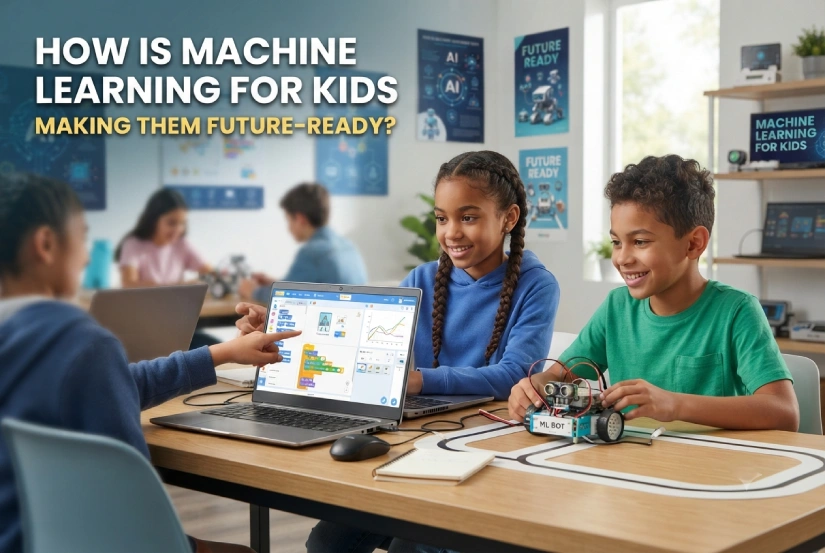
How is Machine Learning for Kids Making Them Future-Ready?
Machine learning is no longer something reserved for tech and science professionals. Kids can now explore its basics through age-appropriate games, activities, and creative projects. By learning how machines recognise patterns, respond to information, and make predictions, children start developing skills that go beyond coding. Machine learning for kids motivates curiosity, problem-solving, creativity, logical thinking, and experimentation. Additionally, it helps kids understand how the technology behind diverse everyday tools works.
From voice assistants and recommendation systems to smart games and image recognition, AI is already part of their world. Introducing children to these vast concepts early can help them become confident technology users and thoughtful creators. More importantly, learning Machine Learning for kids can make technology feel less intimidating and more exciting, giving them opportunities to hone their skills, ask questions, build solutions, and test ideas for the future. Let’s discuss some exciting and fun ways Machine Learning can make kids ready for the future.
Fun and Exciting Ways Machine Learning for Kids Makes Them Future-Ready
Here are some exciting ways Machine Learning for kids works wonders for their growing and fresh minds in future-driven technologies:
1. Turns Learning into Experimentation
Machine learning makes children learn by doing things. Children may train simple models, modify the input, and see the output. It makes technology interesting for children and teaches them that making mistakes is normal during the learning process. With time, children become more relaxed while trying something, experimenting, testing, observing, and practicing in order to improve their projects.
2. Encourages Problem Solving
Machine learning for kids gives them problems that require logical thinking and patience. One needs to understand why a model does what it does, organize the input, or identify a pattern. All this encourages kids to break a problem down into smaller parts, which is an important skill to analyze any problem and use in mathematics, coding, and other sciences.
3. Stimulates Creative Thinking
Machine learning is not only mathematics. Children may combine their creative activities, like storytelling, drawing, playing, and making music, with technology, creating interesting projects where they apply machine learning concepts. For instance, one may try to create an intelligent character, make an interactive game, or teach a computer to distinguish various objects based on images.
4. Makes Children Data Literate
Data plays a crucial role in machine learning. Therefore, this topic is great for children to learn the basics of data literacy. Kids understand that computers need examples and information to recognize patterns. Even simple activities with images, sound, and categorizations will show them how to collect and process information in the world of technology.
5. Develops Computational Thinking
Various machine learning for kids activities develop their abilities to find patterns, make logical steps, classify data, and evaluate the results. Children learn computational thinking skills, which may be useful even without programming. Learning systematic thinking is very helpful while approaching new tasks in the future.
6. Demystifies Artificial Intelligence
Kids use AI on the Internet almost every day: in applications, games, search engines, and digital assistants. Learning basic machine learning concepts helps them to demystify this topic and understand how artificial intelligence works. They learn what lies behind the screen and why computers learn from examples and give certain results.
7. Inculcates Responsible Technology Use
One more benefit of learning machine learning for kids is opening the topic for discussion about fairness, privacy, accuracy, and responsible use of technologies. Children can understand that computers are not able to make perfect decisions automatically and that the information on which they are trained is important. Kids will learn to criticize technology and think about the role of people in it.
Best Time to Introduce Machine Learning to Kids by Age Group
Machine Learning for kids does not need to look difficult at first. The right entry point relies heavily on age and kids’ skills development:
1. Ages 6 to 8
At this early stage, children can begin experimenting with machine learning through various games, visualization activities, sorting tasks, and pattern recognition. The emphasis must still be on sparking interest without introducing too many terms or concepts. However, activities aimed at demonstrating the capacity of machines to learn by example can help to develop observation, sequencing, classification, and reasoning skills.
2. Ages 9 to 11
Children aged between nine and eleven years old can begin experimenting with basic machine learning platforms and block-based coding. They can try to create simple models using pictures, audio files, or text under the supervision of an adult. Projects must not be too long since the process of creating simple examples and watching computer reactions is particularly rewarding for children.
3. Ages 12 to 14
In this case, pre-teens can learn about machine learning for kids through more complicated and structured projects involving working with data, classifications, predictions, and programming skills. At this point, it becomes possible to explain why some models do not work and teach children the necessity of having proper data and adequate design. Discussions about AI ethics, biases, privacy, and responsible behavior online are helpful too.
4. Ages 15 to 17
Teenagers can move to more complicated concepts related to machine learning, programming skills, datasets, and various applications. They might even create portfolio projects and evaluate model performance. Machine learning for kids can be linked to different subjects like science, math, business, and creative technology. Therefore, projects will become increasingly significant at this stage of learning.
It’s Time to Indulge Your Kids in Machine Learning with MasterJi Coding Classes!
Want to introduce your child to the exciting world of Artificial Intelligence without making learning feel complicated? MasterJi Coding Classes is here to help turn machine learning for kids into engaging, age-appropriate learning experiences. Through practical activities, guided projects, and an interactive approach, children can explore how smart technologies work while developing creativity, problem-solving, digital skills, and logical thinking.
Whether your child is taking their first steps into technology or is all set to start this coding and AI journey, the right guidance can make the journey more meaningful and enjoyable. So, do not wait any longer. Connect with us today and give your child an opportunity to explore machine learning, experiment with ideas, hone their creative minds, and start building skills for a technology-driven future.
Frequently Asked Questions
Yes. At younger ages, learners can start with visuals, games, patterns, classification, and even experiments. Advanced math becomes necessary once students approach machine learning technically.
No. At first, children can play with basic principles of artificial intelligence and machine learning with visual, no-code, or block-based environments.
Based on the age of children, projects may range from image or sound classifiers, various interactive games, storytelling, recommendation systems, and more.
Parents can encourage experiments, ask questions, explain how things work, and create some projects. Talking about the results is always beneficial.
Definitely! Machine learning may be tied to art, music, games, storytelling, science, and other fields. Children do not have to become programmers to learn AI principles.
Traditional coding means that one gives commands to the computer and tells it what to do. Machine learning is all about making computers learn patterns from data or examples.
The course has to include age-appropriate teaching, interesting hands-on projects, explanations, space for experiments, responsible discussion of AI, and adaptation of the material according to children’s level and interests.