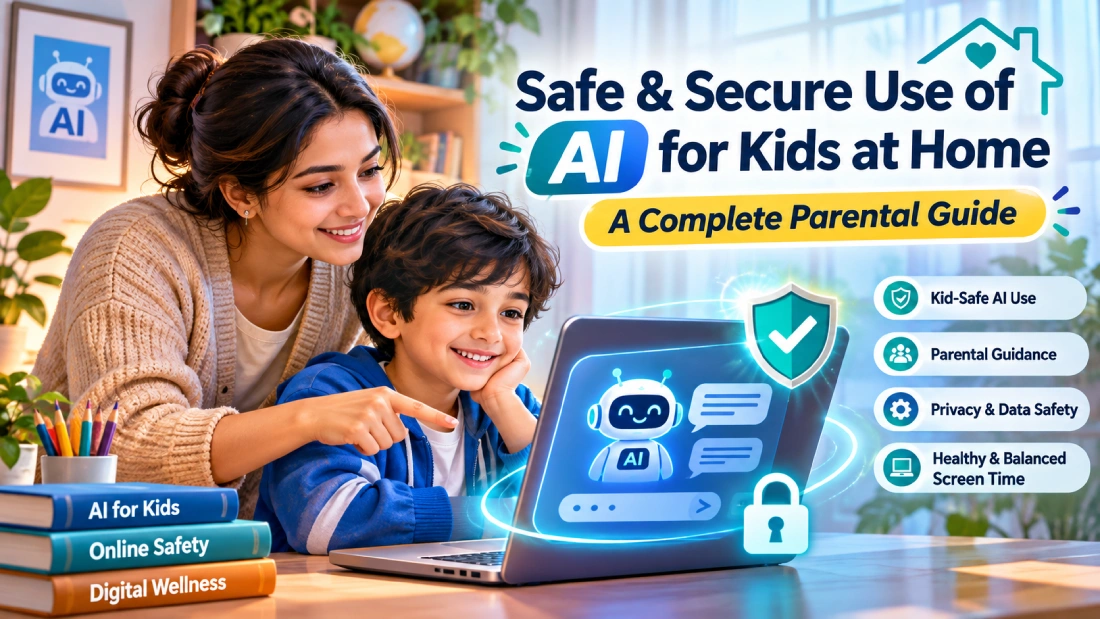
Safe & Secure Use of AI for Kids at Home – A Complete Parental Guide
Artificial Intelligence (AI) is becoming a genuine part of every kid’s learning experiences, from interactive educational applications to intelligent games and virtual assistants. While these tools offer exciting opportunities to explore new ideas, encourage creativity, and develop problem-solving skills, they also raise significant questions about privacy, online safety, and responsible technology use. For parents, understanding how to introduce AI for kids safely at home is part of creating a positive digital learning environment.
Children do not need to become technology experts overnight. Instead, they need age-appropriate guidance, opportunities to experiment with AI, and clear boundaries with adult supervision. Therefore, parents can help their kids understand that AI for kids is a helpful tool, not an unquestionable source of information. In this complete guide, we will explore some practical ways to introduce AI at home, encourage independent thinking, protect children’s personal information, and be a meaningful part of everyday learning.
A Brief Overview of AI for Kid
AI for kids introduces kids to artificial intelligence through interactive activities, coding exercises, age-appropriate digital tools, educational applications, and creative projects. Therefore, it helps young learners understand how machines recognise different patterns, process information, generate content, and respond to questions. Rather than concentrating only on complicated technical concepts, AI education develops practical skills that kids can use in school and everyday life.
For example, children can explore image recognition, experiment with beginner-friendly coding platforms, create simple chatbots, or use AI-assisted tools to brainstorm new project ideas. Furthermore, these creative activities develop logical reasoning, analytical thinking, creativity, and problem-solving skills. However, children should also learn that AI can make mistakes and produce misleading information. Thus, combining hands-on exploration with adult guidance helps them build technological confidence while developing responsible digital habits at an early age.
Why Should Children Learn About AI to Shape Their Future?
Artificial intelligence impacts education, healthcare, communications, entertainment, and many other industries. Introducing AI for kids to children can assist them in understanding new technologies and being ready for their future in terms of developing digital literacy. Teaching children how to use technology is not the main goal. Rather, it should foster a critical, productive, and responsible attitude toward artificial intelligence. Some of the benefits of AI education for children include:
- Helps develop problem-solving skills: AI-based tasks promote the ability to find problems and to try different ways of solving them, and such skills will be helpful in math and science education.
- Fosters creativity and innovation: Kids can apply AI-supervised tools to generate stories, design ideas, illustrations, and other creative projects, adding personal ideas to those tasks.
- Promotes coding and computational thinking: Simple AI projects teach the basic principles of algorithms, patterns, sequences, and instructions that serve as a basis for further coding education.
- Fosters digital literacy: When kids learn how AI functions, they are able to distinguish wrong information and question any digital material.
- Promotes responsible usage of technologies: Learning about privacy, fairness, biases, and accountability will help children think about the consequences of their actions when using intelligent systems.
Creative Ways Parents Can Guide Children While Using AI
These are some practical steps that parents could take in order to make the process of AI learning more efficient and safe, as well as to ensure enjoyment in studying.
1. Pick Age-Appropriate and Reliable AI Applications
When it comes to AI for kids, pick out the platforms that correspond to the age group or level of education of your child. Consider the privacy policy of the platform, minimum age requirements, possibilities of setting up parental controls, data tracking features, and moderation of the content provided by the website. Avoid platforms that require entering a lot of personal information or unlimited interaction. In case your child is too young, give priority to supervised educational applications. This way, your child will have no problems finding something inappropriate online.
2. Set the Basic Household Rules
Make sure that your kid understands what should not be shared with the application. Explain that personal information such as full names, addresses, phone numbers, school names, passwords, and photos should not be shared with any application without prior supervision from adults. Children need to stop using the application if it asks them to enter some personal information or gives an unpleasant result. Set up some basic household rules related to screen time, online behavior, and approved platforms.
3. Engage in Learning AI Together through Practical Activities
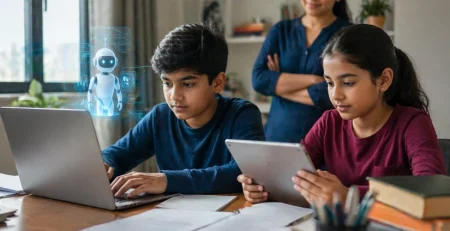
Do not allow children to explore the tools alone. Join the AI for kids learning process by using the educational chatbot to investigate scientific questions, discover how image recognition works, or code a simple project together. Get children to explain what the tool does and ask them to comment on whether the answer makes any sense. Practical activities will help you find the mistakes and correct the misconceptions, and also encourage kids’ curiosity. Most importantly, learning together will make children feel more comfortable sharing the experience and getting help in case something is wrong.
4. Train Kids to Be Critical toward Information Generated by AI
Some AI tools may generate convincing answers that still may contain some facts that are not true, some outdated information, or simply incorrect explanations. Tell children to regard the answers provided by the AI tools as an opportunity to start researching the problem rather than as a proven fact. Compare the information provided with textbooks, educational online sources, and advice from your teacher while researching for school. Try asking questions such as, “What proves that the answer is right?” and “Is there another answer to the same?” This way, children can strengthen their critical thinking and research skills.
5. Fostering Innovation Instead of Overrelianc
Children can use AI technology to generate ideas, comprehend complicated subjects, and examine different viewpoints, but the use of AI should not be an excuse for children not to try. Encourage the child to try solving a problem on their own before asking for help from a digital device. For written tasks, AI could assist the child in formulating the outline of the paper, whereas the child will write the argument and the answer themselves. The same goes for coding tasks where AI can help identify mistakes but will not solve all problems automatically.
It’s Time to Conclude Here!
We hope this blog has provided you with all the precise details of effective tips parents can use to guide their children while using AI. Furthermore, at MasterJi Coding Classes, kids can explore through structured coding education and practical learning opportunities designed to build computational thinking and confidence. With suitable guidance, kids can progress from simply using digital applications to understanding how technology works and creating their own projects. Introducing AI for kids to your kids alongside foundational programming skills can make this journey more engaging and purposeful.
Thus, are you ready to help your kids take the next step in technology learning? Explore MasterJi Coding Classes and discover learning opportunities that can guide your child to build coding skills, embrace creativity, and prepare for an AI-driven future.
Frequently Asked Questions (FAQ)
Basic concepts of AI can be introduced to kids during their early years through some supervised activities. More complex forms can be taught once the kids get better at reading, reasoning, and using the computer.
There is a safer way of using AI tools as long as the parents choose appropriate tools, supervise their interaction with AI, and set clear rules.
- Check privacy settings and data collection.
- Use parental controls when possible.
- Talk to your kids about inappropriate content and how to report it.
- Ensure your kids know about online safety.
- Not even one tool will be completely free from risks.
The best tools are different depending on a kid’s age and learning goals. You can think of simple coding platforms for beginners, educational chatbots under supervision, and applications for creativity that have proper privacy protection.
Children must be told never to give out their passwords, addresses, school-related information, etc. One must also check if the service is saving any of the uploaded information to improve itself.
Yes. AI-driven coding software can teach about programming fundamentals, provide coding solutions, and find out coding errors. Nevertheless, it is necessary that children themselves code, test, and solve the problem.
Need more clarity on our online classes? Book a free demo class!